

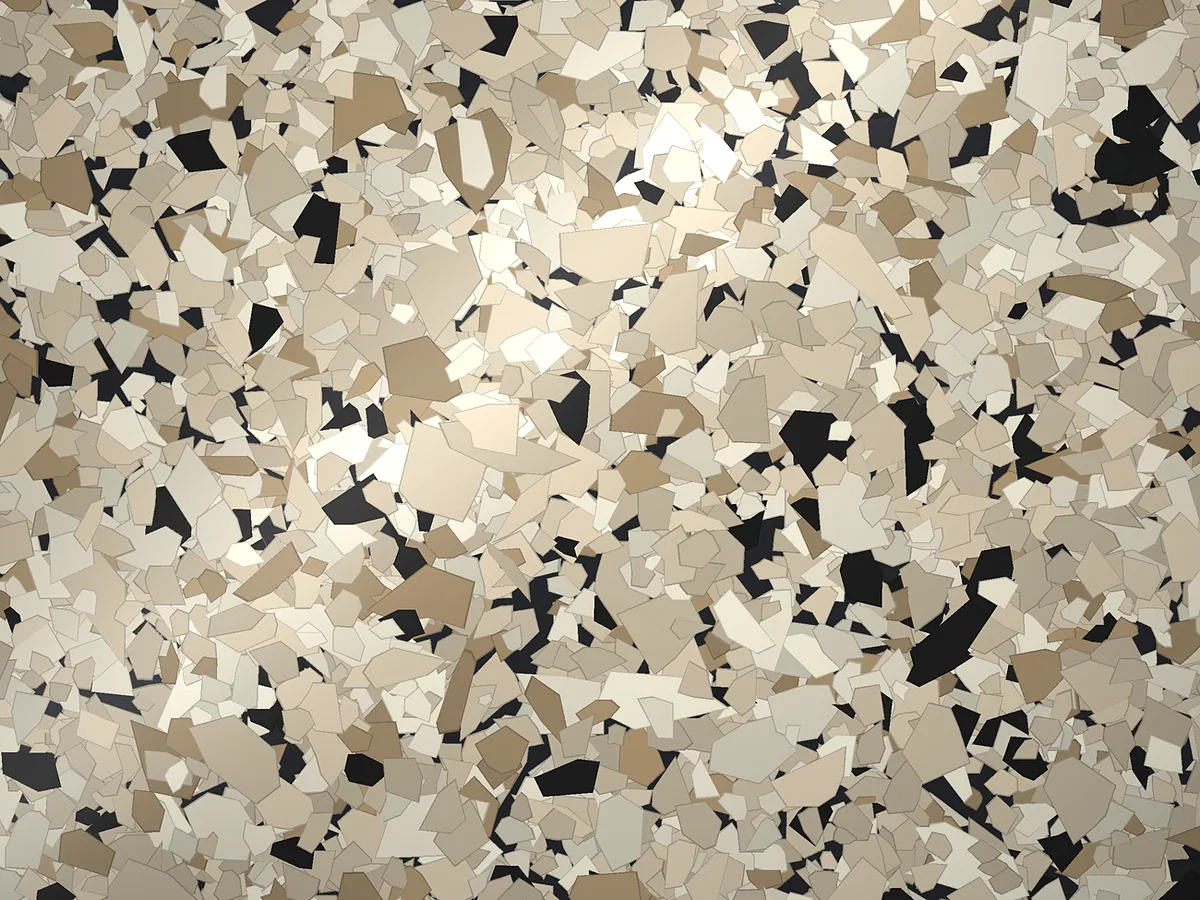
How Coastline reads on a finished floor
From standing height, Coastline reads as one soft beige floor. The cream and ivory chips sit close together in lightness, so they merge into a single warm field, and the black shows as a fine pepper speck rather than a pattern.
Get down to arm's length and it separates into three tones of tan, from pale ivory through cream to a mid light brown, with sharp black chips scattered through. The light brown is what gives Coastline depth up close. Without it, cream and ivory alone would look close to a solid painted floor.
Where Coastline works
Coastline suits rooms that are already warm: wood trim, cream or tan walls, brown cabinets, brick, or a house with beige siding where the open garage door faces the street. It is a light floor, so it brightens a dim garage, basement, mudroom or laundry room.
It is the wrong pick when the customer wants gray or modern. For a pale floor with less yellow, show Canyon. For a light floor that mixes gray and tan, show River Rocks.
Dirt and lighting
Coastline hides what matches it: sand, dry dust, tan mud and dried leaf debris. It shows what is darker: black tire marks, oil drips and wet dirt. The small share of black chips helps a little with dark crumbs, but a light floor is never as forgiving of tire marks as a dark one.
Lighting moves it more than you might expect. Under warm bulbs the floor reads golden beige. Under cool white or daylight fixtures it reads paler, closer to a light greige. Show the customer chips under the fixtures that will actually hang in the room.
A warm blend has one quiet advantage: a slight amber shift in a clear coat is harder to see over cream than over white or cool gray. It is not invisible, so still use the topcoat your resin maker specifies for floors that see sun.
What base coat goes under Coastline?
Tint the base coat tan or beige, close to the cream chip, which is about half the blend. Resin makers recommend tinting the base to one of the colors in the blend because a single broadcast may not cover completely.
With a cream-matched base, any thin spot reads as one more chip. A gray base would show through as cold patches, and a black one as holes.
Matching an existing floor
Coastline is comparable in color to Shoreline (Torginol). Describe Coastline to customers from the chips, not from either name: more than 80% of it is cream and ivory, so it is a light floor. If a customer pictures a dark, brown and black floor, show them chips before you quote.
When you are matching an existing floor, broadcast a small test board from the first box over the base coat you plan to use, topcoat it, and set it beside the old floor before you commit the whole job.
How much Coastline should I order?
A 22 x 24 ft garage (528 sq ft) takes 3 boxes of Coastline at a full broadcast, $255 before freight. Two boxes fall just short, even at the typical rate.
The math: a full broadcast of 1/4 in flake typically uses 0.14 to 0.20 lb per sq ft. At the typical rate of 0.167, this floor needs about 88.2 lb, a little more than the 88 lb in two 44 lb boxes. At the planning rate of 0.20, it needs about 106 lb. Two boxes leave nothing for a heavy hand, a second pass on a thin spot or a stem wall, so order the third. Run your own square footage in the flake calculator.


